Video Case
RGBW vs RGBA: Why Amber Needs Its Own Channel in Facade Lighting
RGBW gives you red, green, blue and a white LED. That white is never amber — and on a 2200 K heritage facade, that single difference decides the project.
Ask any LED engineer about pixel lights and you will hear two colour systems: RGB, and RGBW. Ask about heritage facades, ancient Chinese architecture or temple lighting, and you will hear a third: RGBA. These are not interchangeable, and the difference between them shows up in the finished installation — not on a datasheet, but on the wall.
This film walks through the three colour systems in the order the problem actually appears: what is inside an RGBW package, why its white drifts as you dim it, and why it simply cannot deliver the 2200 K amber that traditional architecture usually specifies. Then we look at what a dedicated amber channel actually changes.
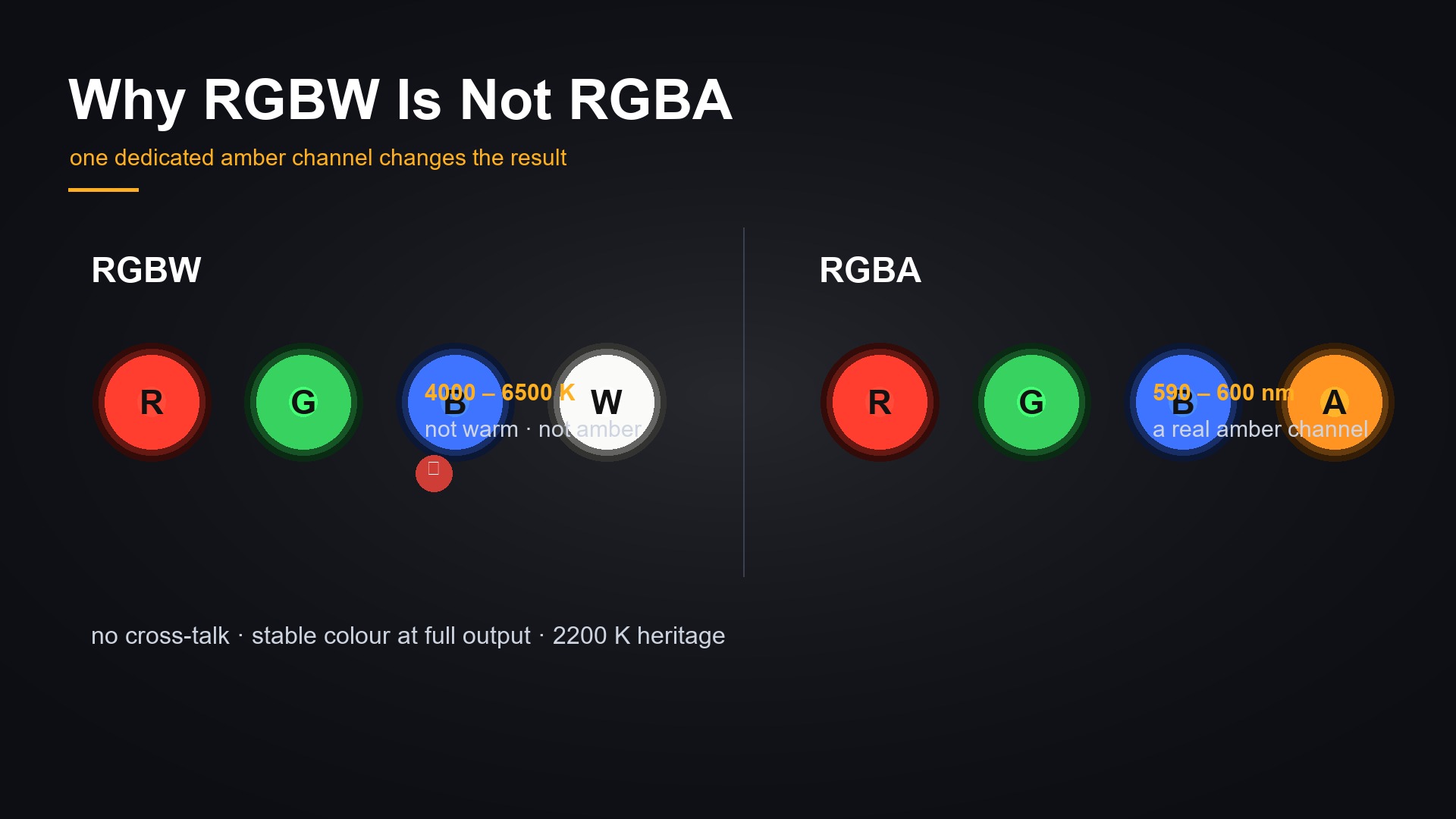
An RGBW fixture carries four emitters per chip: red, green and blue, plus a dedicated white. That white is a phosphor — and on the overwhelming majority of products it is 4000 K, 5000 K or 6500 K. It is a neutral or cool white. It is not a warm white, and it is not amber.
That single fact is the root of most of the confusion in the specification stage, because “RGBW” gets written into a schedule next to “2200 K amber” and everyone assumes the two can be reconciled in the same fixture. They cannot.
The reason RGBW exists is efficiency. Mixing red, green and blue at full output produces a white with a strong magenta cast and poor colour rendering, so manufacturers add a white channel and dim the RGB down to a low level. At low levels the dedicated white dominates and you get a clean neutral white.
The compromise is that the RGB emitters are still lit. They are simply contributing less. This creates two practical consequences:
Different manufacturers isolate the channels to different degrees, so this is not a failure of any one brand. It is a property of parallel RGB plus white.
Traditional Chinese architectural lighting — temples, pagoda complexes, traditional courtyard and heritage renovation projects — is usually specified at around 2200 K. That is a deep, warm, slightly orange white, and it is the colour that makes timber and traditional roof forms read correctly at night.
An RGBW fixture cannot produce it from its own white channel, because that channel is 4000 K or cooler. You can approximate amber by mixing red and green and taking the blue to zero, but that is a synthesised colour rather than an amber phosphor:
RGBA replaces the dedicated white with a dedicated amber, typically peaking around 590 to 600 nanometres. The architectural consequence is larger than the datasheet difference:
On a facade where the specification is amber, this is not a preference. It is the difference between a fixture that can meet the specification and one that cannot.
Anywhere the colour specification is written in Kelvin rather than in “RGB”: heritage and traditional architecture, temple and pagoda lighting, hotel and resort facades where the architecture is warm-toned, and media walls that need a clean amber tier separate from the RGB mix. In each of these cases the choice of colour system is decided at the specification stage, long before the first fixture is ordered.
If you are specifying colour-critical architectural lighting, send us the drawings and the required CCT. We will come back with a fixture layout proposal, a power and control calculation, and a quotation within 24 hours.

Send us your facade drawings or reference photos — we'll reply with a fixture layout proposal and quotation within 24 hours.